
Live from the Nuclear Energy Assembly, NEI President and CEO Maria Korsnick presented the industry’s policy priorities, provided perspective on the future of nuclear, and discussed how the industry is critical to advancing our climate goals, workforce, energy markets, and global partnerships.
State of the Nuclear Energy Industry 2022
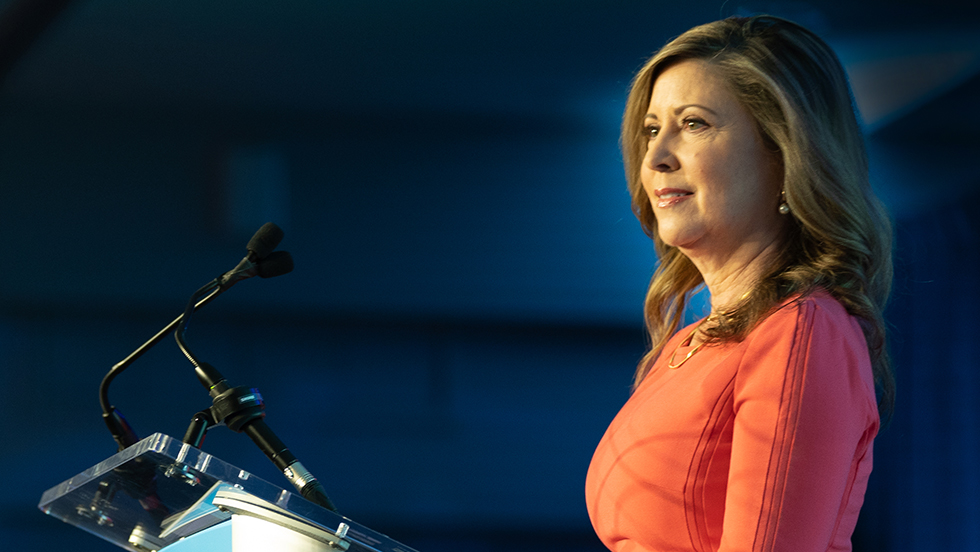
Good morning and welcome to the 2022 Nuclear Energy Assembly. It is so wonderful to be with you in person this year. The energy in this room is incredible.
My special thanks to all of our sponsors, including our premier and premier-plus sponsors: Constellation, North America’s Building Trades Unions, PSEG, Cohesive, Duke Energy and Framatome.
Your support makes NEA possible. We are proud to host this year’s event in partnership with North American Young Generation in Nuclear.
This week is about coming together as we chart the path toward a clean-energy future. It has never been a more exciting time to be a part of the nuclear carbon-free energy industry.
Every year it is my pleasure to deliver the State of the Nuclear Energy Industry address. This year is no different.
We’re at a crossroads for both our industry and the planet. The climate crisis is no longer a vague, theoretical discussion.
Droughts, floods, and wildfires are intensifying. Power blackouts are becoming more common. Our adversaries are manipulating the world’s fuel supply while they threaten the stability of electric grids and abuse their leverage over our allies.
Thankfully, leaders at home and abroad have recognized that our response to the climate crisis is intrinsically tied to our electrical grid, our economy, and our energy security. We now have strong corporate commitments and policy goals to reduce our carbon emissions using every clean energy source at our disposal.
We already know that nuclear energy is the most reliable, scalable, carbon-free option we have. But, if we are content with our current pace, these aggressive plans to decarbonize will remain just that: plans.
We can’t tinker around the edges. We need to have an honest look at what it takes to achieve the true, deep decarbonization that the world desperately needs.
We have to ask: If we were designing a low-carbon energy system to be both reliable and affordable, what would it look like?
For a moment, I want us to imagine a future 30 years from now — after we’ve successfully built that system.
In 30 years, the changing climate will have changed our way of life. Yes, we felt the ongoing consequences.
But, we heeded warnings from the UN and other leading experts. We moved quickly to decarbonize our energy sector. We drastically reduced emissions, and avoided a worst-case ecological disaster.
We did that by investing in every carbon-free source at our disposal — but especially nuclear energy.
We invested heavily in next-generation technology. We also preserved and expanded our existing nuclear capacity while preparing our supply chain to build at scale.
In this clean-energy future, hundreds of reactors — from large, existing models to newer, advanced reactors — dot the landscape. They form the backbone of a stable electric grid that includes large shares of other carbon-free sources like wind, hydropower and solar, alongside the latest in battery storage technology.
This system is anchored by the strength and resilience of our current reactors. They eliminate energy-related air pollution and the illness and death it causes. Nuclear reactors run uninterrupted, every hour of every day, rain or shine.
They only refuel once every few years, and they’re far less prone to supply disruptions and price fluctuations than the coal and gas they replaced.
By mid-century, constructing and operating nuclear plants supports hundreds of thousands, if not millions, of good-paying jobs.
In this future, the United States is energy independent and exporting our technology to allies and partners around the world.
Sounds good, doesn’t it?
The fact is that with the right choices, this future is within our grasp. If we make those choices today, then even the most doubtful voices will finally join the consensus of scientists, CEOs, heads of state, business leaders, and economists around the world:
Nuclear is the key to unlocking a zero-carbon future.
***
I spent a considerable part of the past year attending climate and energy conferences across the world, including COP26 in Glasgow.
Everywhere I went, I saw a sea change in the perception of nuclear energy. It has steadily gained recognition as an indispensable tool for driving down emissions.
Here in Washington, we’ve built a bipartisan coalition committed to that truth.
Support for nuclear starts at the White House. In 2021, the Biden Administration declared the next few years a “can’t miss opportunity” for nuclear. U.S. Energy Secretary Jennifer Granholm has also called nuclear an “absolutely critical part of our decarbonization equation.”
At the other end of Pennsylvania Avenue, a bipartisan majority in Congress recognizes that the path to an affordable, carbon-free future runs through nuclear energy – maintaining our current fleet as well as deployment of new technologies. And they’re backing it up with unprecedented levels of funding.
Last fall, the historic $1.2 trillion infrastructure package delivered major investments in our industry.
It included $6 billion for a civil nuclear credit program that supports existing reactors at risk of closing.
The package doubled down with $2.5 billion towards Advanced Reactor demonstrations, with the goal of deployment before the decade is out. And the bill calls for a large-scale demonstration of carbon-free hydrogen production using nuclear energy.
States have harnessed this support in their transition away from coal. Ten years ago, we would have been lucky to see even a dozen pro-nuclear bills moving through state legislatures. In recent years we’ve seen ten times more action in the states and more than 100 bills supporting nuclear.
Earlier this year, West Virginia lifted its legacy ban on new nuclear projects. The state of Indiana passed a law paving the way for SMR deployment. And with support from the state of Tennessee, TVA announced a $200 million program to explore advanced light-water designs.
Just to show how far the public discussion has come, four communities in Wyoming competed to host the first reactor in the state.
These exciting developments — and I could list many more — build on the strength and resilience of our existing fleet. Nuclear already accounts for nearly 20 percent of total U.S. generation. It remains our largest single source of carbon-free electricity.
This past year also revealed the potential severity of losing that carbon-free capacity. This should not be a political issue. There are no red states or blue states when it comes to heating homes and keeping businesses running.
Take California. At the peak of the pandemic, widespread power outages caused blackouts for hundreds of thousands of residents.
Previously, California decided to prematurely shut down the Diablo Canyon nuclear plant. But the lack of a reliable, carbon-free replacement has led Governor Newsom to reevaluate that decision to prevent future outages for the good people of California.
Last fall, the state of Illinois faced losses of more than twice the amount of clean, nuclear electricity than they sourced from wind and solar combined. Thankfully, the General Assembly voted to preserve its nuclear plants.
As a result, their operator filled 650 vacant jobs, and the legislation jumpstarted more than $300 million in capital projects over the next five years.
***
The momentum we’re seeing at the federal and state level is a testament to the value of our existing fleet and our progress on next-generation technology.
Sources like wind and solar are also essential. Next-generation reactors will pair with them perfectly by providing power when the sun isn’t shining or the wind isn’t blowing.
Nuclear is also the most efficient option. The U.S. Department of Energy has confirmed that building and operating a nuclear plant uses a fraction of the critical minerals and land that solar and offshore wind do.
When it comes to affordability, nuclear is proven to lower overall system costs for the consumer — period. NEI just commissioned a study from the experts at Vibrant Clean Energy to explore the role of nuclear energy as part of a low-carbon electricity system.
This new report shows that nuclear has the potential to provide over 40 percent of U.S. electricity by 2050. A separate scenario with a smaller role for nuclear energy resulted in more than $400 billion in additional costs to consumers over the same time period.
If we rely on wind and solar to do the heavy lifting, the system costs would be truly prohibitive according to research from Stanford University, the Clean Air Task Force, Environmental Defense Fund and other groups.
The upshot is clear: Nuclear is the critical component that actually makes complete decarbonization affordable while keeping our grid reliable.
Ultimately, what makes the new reactor designs so exciting is their even greater versatility.
They open new possibilities for carbon-free energy service at any scale, from the world’s largest cities to remote, rural communities. They can free communities from diesel and fossil fuels without massive new investment in transmission and distribution.
Advanced large designs also are attracting countries like Poland, who have recognized the need to replace the coal-fired power stations that supply nearly three-quarters of their electricity.
Poland and other countries are also looking to smaller, simpler designs to meet their energy security and decarbonization needs. Microreactors with power outputs of up to a few tens of megawatts are a great fit for more isolated regions like Alaska and northern Canada.
Reactors in the hundreds of megawatts are a great fit in areas with larger demand. Just a few weeks ago, NuScale announced a partnership with Romania to build six small modular reactors just outside of Bucharest.
Most recently, the Tennessee Valley Authority partnered with Canada’s Ontario Power Generation to develop and deploy GE Hitachi’s SMR design on both sides of our border. And, as many of you know, we are continuing to make history here at home.
In Waynesboro, GA, Southern Company is completing work on the first commercial reactors built in the United States in more than three decades. The Vogtle 3 reactor, which will go online within a year, will be the first AP1000 advanced pressurized water reactor in the nation.
Vogtle 3 and 4 will produce more carbon-free electricity than all 7,200 wind turbines in the state of California. When the new reactors are complete, the four reactors on site will produce enough carbon-free electricity to power one million homes and businesses in Georgia.
Pressure on the grid will only increase as a result of future demand. These reactors have the capacity to keep up, while offering the flexibility to meet the specific needs of every community.
***
We have evolved beyond talking about “if ” we’re going to build the fleet of tomorrow. We’re talking about “when” and “where.”
But we can’t forget about “who” actually makes it all possible. Generations of electricians, welders, engineers, and operators built the reactors we depend on today.
Today, our industry employs more than 100,000 people directly.
The supply chain employs four times that.
When we build the reactors of tomorrow, we’re going to activate even more segments of the American workforce.
A recent report looked specifically at communities transitioning from coal to nuclear. The report estimated that each small modular reactor sited to replace a retiring coal plant would provide hundreds of on-site jobs.
At coal sites, we estimate that up to 75 percent of the current workforce could transition to work at a nuclear plant. These jobs would exist throughout the entire life of the plant—60 plus years—and pay substantially higher wages.
Hundreds of coal plants are scheduled to close in the next several years —but that shouldn’t leave local economies behind. When we invest in next-generation reactors, they can utilize existing coal infrastructure, which avoids the need for new transmission to connect these plants to the grid.
Advanced nuclear reactors will be local economic engines. They’ll provide quality, secure jobs. They’ll bring tax revenue to support schools, libraries and first responders. And they do it all without emitting air pollutants that harm people’s health.
Building these reactors can make the transition to clean energy a just economic transition. With your help, we’re going to make sure that investments in nuclear energy are investments in working people.
***
Nuclear energy’s potential for decarbonization goes beyond the electric grid. Entire industries are recognizing nuclear’s ability to reduce or erase their carbon footprints.
Transportation and manufacturing alone make up 45 percent of our greenhouse gas emissions. The UN has made it clear that these industries need to accelerate their current progress towards their emissions targets.
That urgency, combined with the technology and tools we already have, has brought new customers into the fold. Leaders in the oil and gas and chemical manufacturing industries are raising their hands in numbers we’ve not seen before.
At an energy conference in Houston earlier this year, Jim Fitterling, the CEO of Dow Chemical, specifically spoke to how SMRs can help his company achieve its decarbonization goals.
Synthos, one of Poland’s major synthetic materials producers, is partnering with GE Hitachi to deploy SMRs.
Nucor, a company synonymous with the steelmaking industry, is investing in NuScale to build a future that will require hundreds of smaller reactors across the country.
Advanced reactors are the solution they’ve been searching for. They can provide the reliable, cost-effective, carbon-free generation needed to decarbonize their supply chains. They enable manufacturers to sell to companies like Ford, GM, Tesla and others who are committed to a lower-carbon future.
Looking ahead, we expect to see even more industrial use of nuclear energy. The off-peak capacity of conventional nuclear reactors can be used today to generate clean hydrogen for the manufacturing and transportation sectors. New technologies will provide the high-temperature heat needed to decarbonize heavy industry. Cutting-edge designs offer advancements in size and efficiency which can revolutionize processes like steel-making and transportation for ships and aircraft.
***
In a time when we badly need it, we are staring at an unprecedented opportunity to rebuild our leverage in the global supply chain. As the world’s leader in nuclear output, we can export our standards along with our technology.
Nuclear energy innovation in America — from universities, to national laboratories, to the private sector — is fueling the fleet of tomorrow.
The choice to build alongside our allies and partners is no small decision. Nuclear development forges economic and security relationships that can last 100 years.
Russia’s brutal invasion of Ukraine has underscored the link between energy security and national security. As an industry and as a democracy, we stand with Ukraine and our partners across the globe.
That’s why we are working with the Administration, with Congress, and with our allies to establish a secure and reliable uranium fuel supply that will eliminate the need for Russian imports.
I won’t sugarcoat the current difficulties. While the decision is simple from a diplomatic and moral standpoint, it won’t be easy to execute — and it can’t be done overnight.
Keeping plants online will require an all-hands-on-deck effort: from fuel suppliers, utilities, investors, and others. We need to have the same goal: eliminate dependency on Russian fuel services without sacrificing reliable, affordable carbon-free power.
We will also need federal support to re-establish U.S. leadership in fuel conversion and enrichment capabilities. We have the ability to develop a secure fuel supply for the world’s nuclear reactors.
Nuclear energy provides a necessary level of protection from daily price fluctuations and the whims of foreign dictators and bad actors. Our plants go roughly a year and a half, or even longer, between refuelings.
Right now, European nations in particular are searching for ways to break their dependence on Russian energy. We’ve already seen Finland cancel plans for a Russian-built reactor, and the Czech Republic left both Russia and China off their invitation to submit proposals for new plants.
The ongoing partnership between Westinghouse and Ukraine in both fuel supply and new builds is a testament to the value of our global partnerships.
***
If we are going to reach our climate goals, we can’t sacrifice any of the reliable, secure, independent power that we already have. As license renewals come up, we must do everything we can to keep existing reactors online.
We know that when nuclear plants shut down, carbon-emitting sources like coal and natural gas usually fill the void, driving up emissions.
Right now, Germany is shuttering three of its nuclear plants and planning to completely phase out the source by the end of the year. Energy prices are soaring. Their deadline to reach net zero emissions is approaching.
And yet, we’re seeing Europe’s largest economy revert to fossil fuels.
That isn't decarbonizing, it’s running in the opposite direction of our climate goals.
Thankfully, other countries that were on a similar path are now abruptly changing course. Three weeks after Russia launched their invasion, a survey commissioned by Citi Research found a 25 percent increase in support for new nuclear construction among European residents.
Belgium has extended the life of their operating plants by a decade. South Korea and the Netherlands are now committing to build new plants, while the United Kingdom and Czech Republic are increasing their targets for new capacity.
France, a country that planned to phase down nuclear, recently announced plans to build up to 14 new plants by 2050.
That’s the kind of decision-making we need, all over the world.
***
At this point, our challenge isn’t a lack of demand — it’s being able to build fast enough to meet the demand before us.
First, the Nuclear Regulatory Commission is going to face a rapidly growing volume of applications for new reactors. If we’re going to build them, we need a more efficient process. Regulators must have the capacity to efficiently review and approve licenses for new designs so these reactors can come online.
We are not talking about demand for 10 or even 20 reactors. NEI recently polled Chief Nuclear Officers at our member utilities. Together, they are expecting to add 90 gigawatts of nuclear power to the grid in the U.S. — the bulk of that coming online by 2050.
That translates to about 300 new small modular reactors in the next 25 years. That type of production would double U.S. nuclear output today.
Here’s the thing: That estimate only includes utilities that already operate nuclear plants. It doesn’t include the growing list of utilities who are new to nuclear and demonstrating interest in advanced technologies.
Right now, the DOE Loan Programs Office is working on several applications for nuclear projects here in the U.S. The Export-Import Bank is working to mobilize funding for overseas customers who want to do business with us.
The overall opportunity is massive. According to one estimate, revenues for U.S. companies alone could be worth up to $1.9 trillion in exports over the next 30 years. That’s value we can’t afford to miss out on.
But we can’t afford to wait around for big banks and credit rating agencies who are trying to decide how nuclear fits in the puzzle. Technology tribalism can’t be a barrier to our most proven solutions.
I began with a vision of the next 30 years. If we’re going to achieve that future, we can’t wait another year — or even the next six months — to act.
That’s what I want our leaders, and everyone here today, to keep in mind. At COP 27, the Clean Energy Ministerial, and every other forum where critical decisions are being made about our climate and energy future, we need to be crystal clear.
If we don’t commit to the next generation of nuclear now, our hesitation will cost our electric grid, our economy, and our environment. The train is leaving the station.
It’s time to go all-in on nuclear energy.
I know we can make it happen together.
Thank you.