
Live from the annual Nuclear Energy Policy Forum, NEI President and CEO Maria Korsnick presented industry policy priorities and shared her perspective on the present and future state of nuclear energy.
Key Takeaways
- Demand from AI and data centers are bringing Big Tech to the nuclear table.
- Private capital is pouring into nuclear, and the U.S. is stepping up to lead on the global stage.
- It's critical that we protect federal programs and policies that preserve and expand nuclear generation.
Transcript
Hello, and welcome to the Nuclear Energy Policy Forum! I want to start by thanking our sponsors: Constellation, PSEG, and GE Vernova Hitachi.
We’re gathered here at an unprecedented moment in our industry’s history.
For two decades, electricity demand has remained fairly stagnant. But now, I think we can all agree: Things have gotten interesting.
American manufacturing. American innovation. Artificial intelligence. All demand more power.
The massive data centers we need to win the race for AI require 28 gigawatts of new electricity by the end of next year.
That’s why, in December, experts increased the five-year load growth forecast by almost 500 percent. And that’s why, over the next ten years, experts also say half of the country is at an increased risk of power outages.
Growth in our sector has gone from incremental to incredible. It all raises the question: How will we meet demand when we need enough electricity to power 20 cities the size of New York City?
It seems almost impossible. Almost. But history has taught us: Where there’s a will, there’s a way.
We know we can generate 60 Hoover Dams-worth of new electricity because that’s what we do in America.
It seemed impossible when President Hoover declared he wanted to build the largest public works project in our nation's history. And it seemed impossible when workers began laying down 44 thousand tons of steel, installing 582 miles of pipe, and pouring 6 million tons of concrete.
But, the whole of the government came together with the innovation of the private sector.
The will found the way. The impossible became possible. And our nation was forever changed.
We are the visionaries of our time.
I am proud to say that the nuclear industry has a future of unlimited potential. But we are facing some headwinds. And the actions we take today will define what that future looks like.
Here in Washington, we are grateful for nuclear’s continued bipartisan support. This is proven by the fact that Secretary of Energy Chris Wright will be joining us today.

And we’re heartened that, on just his third day in office, he signed an order to, and I quote, “unleash commercial nuclear power.”
We are encouraged by this Administration’s recognition of the value of nuclear energy as part of a secure, resilient, affordable, abundant, and increasingly clean energy system.
As the Administration works to unleash commercial nuclear power, NEI has had productive meetings with Secretary Wright and Interior Secretary Burgum to provide recommendations that preserve existing nuclear generation, usher in the deployment and export of next-generation nuclear which will come in many shapes and sizes, secure a reliable domestic fuel supply, and promote efficiency at the Nuclear Regulatory Commission.
Our industry is ready, not only to meet demand, but to break new ground, push the limits, and redefine what’s possible.
This is thanks to all of you…thanks to your hard work tackling one of the hardest challenges facing the world today.
From up here on stage, I can see Don Moul of the Tennessee Valley Authority—another utility that began as a massive public project.
Nearly 100 years later—just this morning, in fact—TVA submitted a construction permit application for the GE Vernova Hitachi BWRX-300. And it’s applied for an $800 million DOE grant, along with a coalition of partners that includes Bechtel, Duke Energy, and GE Hitachi.
I also see Bob Blue, the chair, president, and CEO of Dominion Energy and chair of NEI’s Board. Last year, Dominion secured a 20-year extension for its North Anna Power Station.
And Dominion has also partnered with Amazon to explore SMR technology.
Drew Marsh, where are you? Hi there! Drew is chair and CEO of Entergy and vice chair of NEI’s Board. Entergy is investigating new technologies to meet booming industrial demand, increasing nuclear output, and has secured a site permit for a potential new nuclear reactor in Mississippi.
I also see Joe Dominguez, the president and CEO of Constellation Energy. Constellation drew some of the biggest headlines for nuclear last year when they announced they were restarting Three Mile Island Unit 1 as the Crane Clean Energy Center, with Microsoft as their partner.
All of these examples demonstrate how Big Tech and big industry are betting big on nuclear.
You know, that wasn’t always the case. A few years ago, I found myself in a meeting with a very large company from Silicon Valley. They told me that they would not go nuclear. Fast forward to today, we’re in a new reality.

Google, Meta, and Amazon have joined 14 of the world’s biggest banks and financial institutions to pledge to triple global nuclear capacity by 2050.
Google has also signed a deal with Kairos Power to purchase 500 megawatts of electricity.
Amazon has led a $500 million investment in X-energy and has announced their intent for 5 gigawatts of nuclear power.
Meta put out an RFP for 4 gigawatts of nuclear power.
Just this month, Elementl Power signed an agreement with Google to develop three project sites for advanced reactors.
And Amazon Data Services has also become NEI’s first official member from the Magnificent Seven.
New nuclear partnerships with tech customers total nearly 30 gigawatts of commitments across the U.S., and the numbers keep growing.
But it isn’t just Silicon Valley that’s turning to nuclear. Wall Street is doing the same.
NEI hosts an annual financing summit. This year, we had twice the number of participants as the first summit three years ago. When the conference started, there were limited vehicles to invest in nuclear.
But in 2024, the private sector transaction value in nuclear was more than the prior four years combined.
Corporations aren’t running away from nuclear. They’re running toward us. And our arms are wide open.
The private sector’s growing investment in our industry is matched by the public sector’s support for nuclear.
Last year, Congress provided almost $3 billion to support a domestic fuel supply to eliminate reliance on Russia, and another nearly $1 billion for next-generation reactor demonstrations.
Congress also passed the ADVANCE Act. 88 senators from both parties voted for it.
We have proven that nuclear can unite policymakers from across the aisle. But we aren’t taking anything for granted, especially now.
Our industry is hyper-focused on protecting federal policies and programs that preserve and expand nuclear generation.
I’m talking about programs like the Advanced Reactor Demonstration Program and the Loan Programs Office, and policies like the nuclear tax credits.
Just recently, NEI joined more than 120 of our member companies to send a letter to Congressional leadership, urging them to retain the credits.
Think about what life was like before the tax credits. We were prematurely shutting down nuclear plants. But after those tax credits were passed, we started to see power uprates, plant restarts, and decades-long reactor extensions.
All of that progress, the technological boom it’s fueling, the financial boon it’s fostering…all of that could slow down or turn around completely if Congress fails to preserve the nuclear credits.
The current language we’ve seen from the House phases out much-needed support. But we are not giving up. And we will be out there pounding the pavement every step of the way.
Here’s the bottom line: Nuclear tax credits support good jobs, thriving communities, and national security.
Today, members of Congress have a choice: To shape the future or stand in its way. Let me be clear: Nuclear tax credits are absolutely essential to move our nation forward.
To move forward we also need modernization at the Nuclear Regulatory Commission. And we’re encouraged by the progress we’ve seen.
The ADVANCE Act directed the NRC to prioritize efficiency alongside safety. They have since revised its mission statement to acknowledge that. And we’re seeing it take hold.
This year, the agency began approving subsequent license renewals for the first time since 2021.
One example of that progress is Xcel Energy’s subsequent license renewal review for its Monticello Plant.

It was expected to take 24,000 hours. But it ended up taking just 16,000 hours, decreasing the review time by one third. This efficiency needs to become the rule rather than the exception.
At the state level, leaders are also moving from restriction to expansion.
Last year, 25 states took pro-nuclear action and 7 state public utility commissions approved orders or took action in support of nuclear.
And this year, 11 governors mentioned nuclear in their State of the State addresses. And their words havbeen matched with action.
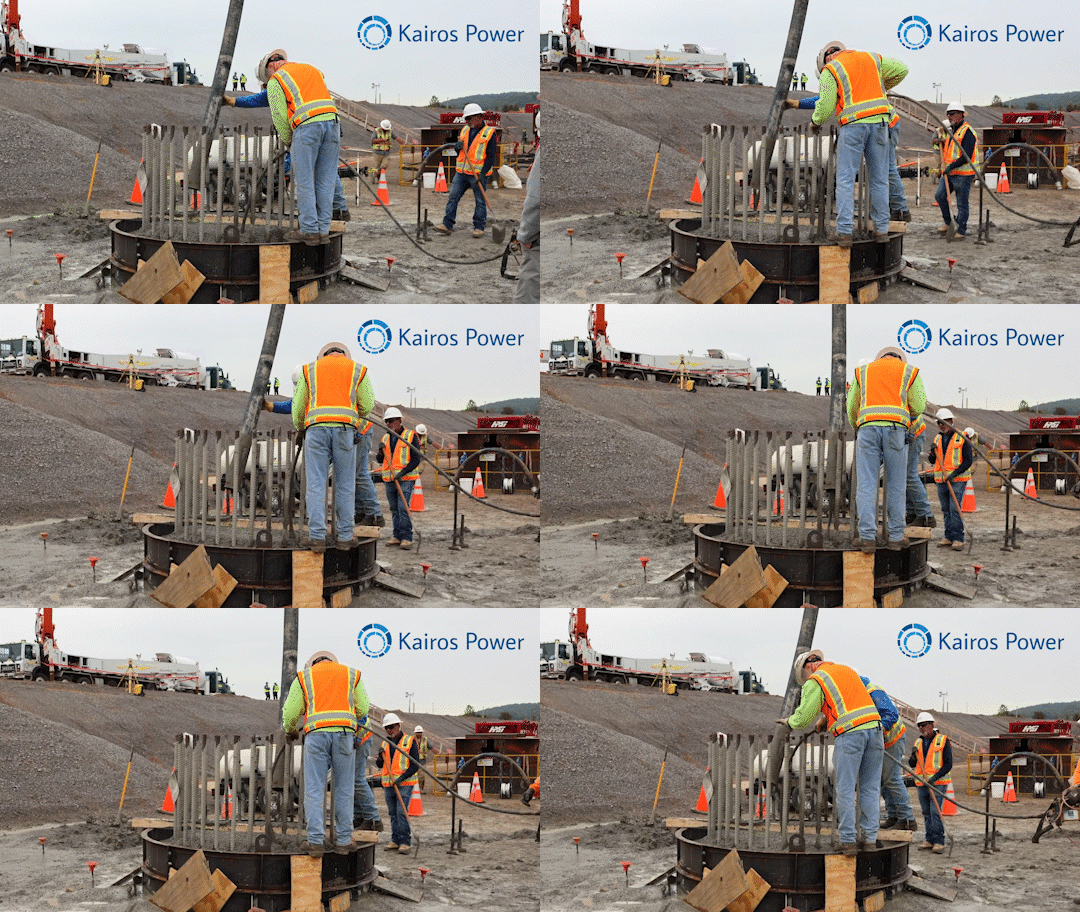
In Tennessee, Kairos Power is building the first of two new demonstration reactors—and the concrete is drying as we speak.
In Wyoming, TerraPower is building the state’s first commercial reactor.
In Colorado, a bill passed recognizing nuclear as clean energy.
Texas is developing a Nuclear Energy Fund, which could become the largest investment in nuclear from any state.
And in Idaho, the Department of Defense is building one of the country’s first microreactors.
Last year, I visited Idaho National Laboratory, and I got to see the DOME facility where they pioneered fast reactor technology.
Now, INL has repurposed that facility to test microreactors—which will become another breakthrough innovation. In fact, Westinghouse and Radiant Industries secured an award last year to test their microreactor designs at the facility.
Success at home is being reflected by expansion abroad. Internationally, nuclear has gone from the fringes of the energy conversation to the center.
Our nation’s competitors are trying to seize their own momentum on nuclear. Russia is building 10 reactors across the globe. And China has 30 reactors under construction within its borders.
In response, other countries are trying to achieve energy independence through nuclear.

In Canada, just this month, Ontario Power Generation cleared the last hurdle before construction begins on the GE Vernova Small Modular Reactor at the Darlington site. This is a big win for the North American nuclear industry and the clean energy future we’re building together.
In Japan, the latest national energy plan calls for sourcing 20 percent of its electricity needs from nuclear by 2040.
In Germany, a majority of people now support restarting the country’s nuclear program. And just this week, the Financial Times reported that Germany will no longer block efforts to ensure nuclear power is treated the same as renewable energy in EU legislation.
In the United Kingdom, the government has approved eight sites for future nuclear development, and the Prime Minister has called for even more expansion.
In fact, UK Ambassador Peter Mandelson is here today. Thank you, Mr. Ambassador, for joining us, and for helping build transatlantic ties for nuclear.
Other countries are walking back their own restrictions. 35 years ago, Italy closed its last nuclear plant. But in February, the nation passed a law to begin transitioning back to nuclear.
And countries that were already pro-nuclear are redoubling their efforts. Bulgaria, Romania, and India are all moving forward with new nuclear plants.
The U.S. has the chance to help countries establish their own programs. To name just one example, Poland is partnering with Westinghouse and Bechtel to build its very first reactor—and I recently visited, alongside Secretary Wright, to keep strengthening this relationship.
NEI has been part of conversations like these across the world. Over the past 12 months, I’ve led trade missions to Sweden, Finland, the UK and the Netherlands, I’ve led an executive delegation to Poland, and I’ve represented the U.S. industry at events hosted by the International Atomic Energy Agency and the OECD.
Everywhere I’ve gone, it’s been clear: We’re front of mind for so many leaders, policymakers, and entrepreneurs. Our allies and our adversaries are competing to become global leaders in nuclear. If our leaders on Capitol Hill do not protect existing policies and programs,
America will fall behind.

61 percent of Americans now support nuclear energy—that’s the highest level in 15 years.
When it comes to energy needs, nuclear has gone from being an afterthought to being the first call. Our industry is responding to this unprecedented interest by taking unprecedented action.
This year, we celebrated the 1-year anniversary of Project Vogtle’s completion. It has proven that advanced nuclear is possible.
And just look at what else we’ve accomplished since we last gathered.
Two plant restart applications, two initial license renewals to 40 years and six subsequent license renewals to 80 years granted, and more than 25 new projects in the pipeline.
And there is more to come. Our members plan to submit at least eight construction permit applications for new reactors and four operating license applications for new reactors.
This would enable construction to begin on five sites and operations to begin in the next two years for two microreactors.
Plant restarts are also on the horizon—like Holtec’s Palisades Plant in Michigan. And NextEra is exploring the viability of resuming operations at the Duane Arnold Plant in Iowa.
Still, we have to face a hard truth: Even if all of that goes according to plan, it won’t be enough to meet rising energy needs.
We cannot afford to go backwards. Federal policies and programs not only incentivize new nuclear generation, but also protect the clean, reliable power that our current nuclear fleet provides the grid today.
Right now, our industry is like an engine that’s being primed by higher demand. We’re trying to keep up, but inside of that engine, some of the gears aren’t moving at the same speed.
My point is this: We need every stakeholder in this industry to move together. Doing that will take three simple but significant steps.
The first is coordination. We have to get everyone on the same page and in the same room, so we can start making progress toward the same goal.
One such initiative has already started, and it offers a lot of promise. The President established the National Energy Dominance Council, which brings together public officials with private stakeholders to work on everything from opening closed nuclear plants to building new reactors.
Which brings me to the second step: Optimization. When change is happening this fast, there is no long term. There’s only the short term, and the shorter term. And the shortest-term priority for our industry has to be optimizing the system we have right now.
This is an all-hands-on-deck moment for the energy industry, but at the end of the day, nuclear is critical to go the distance.
To keep it that way, we have to watch out for the regulatory drag that could slow down every gear in the engine.
As I’ve already mentioned, the NRC has made progress here. And Chairman Wright realizes the agency still has a ways to go. That’s why, last year, NEI submitted a roadmap to the NRC that would take a 5-year review process for microreactors and streamline it to six months.

This year, we are doubling down on this effort and will continue to call for a host of reforms to streamline the process.
Once we’ve eliminated as much drag as possible, we can all start reaching the same speed—a faster speed. That’s the third and final step: acceleration.
We have to accelerate nuclear deployment. That requires aligning our supply chain today with the needs of tomorrow.
In the coming years, we will see new construction across the energy sector. And many forms of power generation require similar parts, like turbines. But manufacturers might not be able to keep up with demand, even at full speed. Already, some companies are in a years-long wait for a new gas-fired turbine.
Our industry has to get ahead of these supply chain bottlenecks. The same goes for establishing a reliable fuel supply. Our industry is already doing what it can. Centrus, Urenco, Orano, Global Laser Enrichment, General Matter, and LIS Technologies are all making moves to reshore our fuel supply.
There is more to accomplish, and we can’t do it all by ourselves. That’ll take federal support to drive further investments.
And we certainly can’t do it without a domestic nuclear workforce. That’s why we need to expand nuclear and STEM education in schools, universities, and apprenticeships nationwide.
Above all, there is one thing our industry needs to meet this moment. And that’s investment.
I’m talking about the federal government providing a financial backstop for early-mover projects and the leadership that was shown by the introduction of the ARC Act.
I’m talking about bolstering the loan authorities that are fostering private investment in nuclear.
And, yes, I’m talking again about tax credits. They are saving billions of dollars for U.S. households. And because they are being debated right now right here in D.C., the future of our industry is in the hands of Congress and this Administration. So is the future of American energy security.
Whoever leads in AI, will lead the world. It’s a national imperative to ensure that the rate of AI innovation isn’t constrained by the rate of new energy output. The only way to futureproof our grid—the only form of energy that’s clean and reliable—is nuclear. Nuclear is the smart, strategic answer.
So, let’s coordinate, optimize, and accelerate nuclear deployment, so the United States can become the undisputed global leader in nuclear energy.
Imagine the prosperity we could unlock if we did unleash commercial nuclear power.
Imagine the hundreds of thousands of jobs we will create, the millions of homes we will power, the untold innovation we will fuel.
Imagine how this excellence at home will lead to hundreds of billions of dollars in exports abroad.
And imagine how much safer the world will be if the United States established international dominance not just in energy, but in the technology that will help determine the future of geopolitics.
We can accomplish all of this. We can change history, just like the visionaries behind the largest concrete structure since the Pantheon—the Hoover Dam.
At the dedication of that project, President Franklin Delano Roosevelt praised it by saying: “This is an engineering victory of the first order—another great achievement of American resourcefulness, American skill and determination.”
Together, we can make sure the same is said about nuclear power. Together, we can make the impossible possible.
Because nuclear makes it happen. Thank you.


.png?language=en-US)